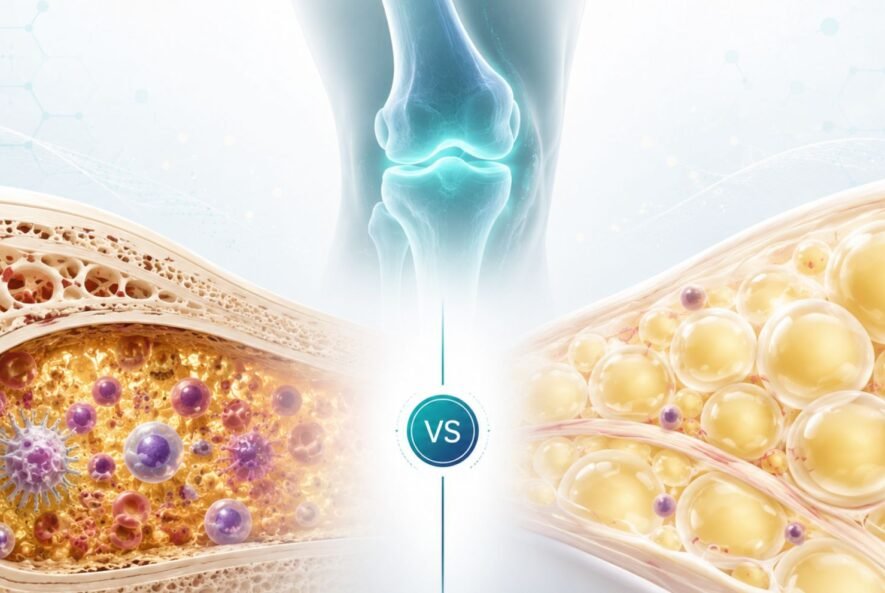
Both bone marrow-derived stem cells (BMSCs) and adipose (fat)-derived stem cells (ADSCs) can support joint healing, but current research suggests they aren’t interchangeable. Bone marrow-derived stem cells generally show a stronger natural tendency to form cartilage (chondrogenic potential), which is why many physicians favor them for osteoarthritis and cartilage-related joint pain. Adipose-derived stem cells are easier to harvest in large quantities and show strong immune-modulating and anti-inflammatory effects, making them a reasonable option for inflammatory joint conditions. The right choice depends on the joint involved, the underlying cause of pain, and a physician’s evaluation — not a one-size-fits-all rule.
What Are Mesenchymal Stem Cells (MSCs)?
Bone marrow and fat tissue are two of the most common sources of **mesenchymal stem cells (MSCs)** — a type of adult stem cell capable of transforming into bone, cartilage, and connective tissue. Both cell types meet the same basic scientific criteria: they attach to lab culture surfaces, express similar surface markers, and can differentiate into multiple tissue types. Where they differ is in how they’re collected, how many cells you get, and how they tend to behave once injected.
For a deeper look at how these cells work in general, see our guide: What Are Stem Cells?
Bone Marrow-Derived Stem Cells (BMSCs)
How They’re Harvested
Bone marrow-derived stem cells are typically collected from the back of the pelvic bone (iliac crest) using a needle aspiration technique performed under local anesthesia. The procedure takes only a few minutes, though it can cause brief pressure or discomfort during collection.
Why Physicians Often Choose Them for Joint Pain
Research comparing the two cell types has consistently found that bone marrow-derived stem cells show **greater chondrogenic differentiation** — meaning they have a stronger natural tendency to become cartilage cells. Several clinical studies on osteoarthritis of the knee, hip, and ankle have reported meaningful pain relief, functional improvement, and evidence of cartilage-related changes following bone marrow-derived stem cell treatment.
Limitations
The harvesting process yields a relatively small number of usable stem cells — often less than 0.01% of the total cells collected — and the procedure itself is somewhat more involved than a fat-tissue harvest.
Adipose-Derived Stem Cells (ADSCs)
How They’re Harvested
Adipose-derived stem cells are collected through a mini-liposuction procedure, typically from the abdomen or flank, under local anesthesia. Fat tissue naturally contains a much higher concentration of stem cells than bone marrow, so this method usually yields significantly more cells per collection.
Why Physicians Consider Them
Beyond the higher cell yield, adipose-derived stem cells have demonstrated strong **immunomodulatory** properties — meaning they’re particularly effective at calming inflammation, which plays a major role in many types of joint pain. Some research also points to easier accessibility and faster cell proliferation compared to bone marrow-derived cells.
Limitations
While abundant, adipose-derived stem cells have generally shown a somewhat lower chondrogenic (cartilage-forming) capacity compared to bone marrow-derived cells in head-to-head laboratory comparisons, though results vary by study and by joint.
Bone Marrow vs. Adipose-Derived Stem Cells at a Glance
| Factor | Bone Marrow-Derived (BMSC) | Adipose-Derived (ADSC) |
|---|---|---|
| Harvest method | Needle aspiration from pelvic bone | Mini-liposuction from fat tissue |
| Cell yield | Lower per sample | Higher per sample |
| Cartilage-forming (chondrogenic) potential | Generally stronger | Generally moderate |
| Anti-inflammatory / immune effects | Present | Often more pronounced |
| Common use cases | Osteoarthritis, cartilage-related joint damage | Inflammatory joint conditions, soft tissue support |
| Procedure discomfort | Brief pressure at the hip | Mild soreness at the harvest site |
So Which One Is Better for Joint Pain?
The honest answer is: it depends on the joint, the condition, and the patient. Some physicians combine both cell sources, or pair them with platelet-rich plasma (PRP), to take advantage of the strengths of each. Factors that typically influence the decision include:
- The joint involved — knees and hips with significant cartilage wear often lean toward bone marrow-derived cells given their chondrogenic strength
- How much inflammation is present — more inflammatory presentations may respond well to the immune-modulating profile of adipose-derived cells
- Patient age and overall health — cell quality from either source can be affected by age-related changes
- Volume needed — larger or multiple joints may benefit from the higher yield adipose tissue provides
This is ultimately a clinical decision that should be made after an in-person evaluation, imaging review, and discussion of your specific joint pain, not from a blog post alone.
Talk to a Physician About Your Options
Every joint and every patient is different, which is why an accurate recommendation requires an in-person evaluation rather than a general comparison. At Stem Cell Miami FL, Dr. Kristopher Sean Goddard and Dr. Jesse Morse evaluate each patient’s joint condition, imaging, and health history to determine whether bone marrow-derived cells, adipose-derived cells, PRP, or a combination approach is the right fit.
Book a Consultation or explore related treatment options: