When rest, stretching, physical therapy, shoe changes, or medication do not provide enough relief, some patients begin researching regenerative medicine options such as PRP therapy and stem cell therapy.
The honest answer is this: stem cell therapy may be discussed as a regenerative option for selected Achilles tendon problems, but it should not be described as a guaranteed cure. Evidence is still evolving, results vary, and a medical evaluation is needed to determine whether regenerative treatment is appropriate.
What Is Achilles Tendonitis?
The Achilles tendon is the strong band of tissue that connects the calf muscles to the heel bone. It helps you walk, run, jump, climb stairs, and push off the ground.
Achilles tendonitis usually refers to irritation or inflammation of the tendon. However, many chronic cases are better described as Achilles tendinopathy because the problem may involve degeneration, thickening, microtears, poor tendon remodeling, and reduced tendon quality rather than simple inflammation alone.
Common symptoms may include:
- Pain at the back of the heel or lower calf
- Morning stiffness
- Pain that worsens with running or jumping
- Tenderness when touching the tendon
- Swelling or thickening around the tendon
- Pain when climbing stairs
- Reduced ability to push off the foot
- Symptoms that improve with rest but return with activity
Achilles tendon pain can affect both athletes and non-athletes. It may develop from overuse, training errors, tight calf muscles, poor footwear, sudden activity changes, aging tendon tissue, or biomechanical stress.
Insertional vs Midportion Achilles Tendonitis
Not all Achilles tendon pain is the same. The location of the pain matters because treatment planning can differ.
Midportion Achilles Tendinopathy
This usually occurs a few centimeters above the heel bone. It is often related to overuse, tendon thickening, and repetitive loading.
Insertional Achilles Tendinopathy
This occurs where the Achilles tendon attaches to the heel bone. It may be associated with heel spurs, calcification, irritation from shoes, and pain with ankle movement.
Diagnosis is important before considering regenerative medicine, PRP therapy, stem cell therapy, or surgery.
What Causes Achilles Tendonitis?
Achilles tendonitis may develop when the tendon is placed under more stress than it can tolerate. Over time, repeated stress can cause irritation, small tendon injuries, and failed healing.
Common contributing factors include:
- Sudden increase in running or exercise
- Hill running or sprinting
- Tight calf muscles
- Poor ankle mobility
- Flat feet or high arches
- Unsupportive footwear
- Aging tendon tissue
- Weak calf muscles
- Previous Achilles injury
- Poor training recovery
- Certain medications or medical conditions
Some patients develop Achilles tendon pain gradually. Others notice symptoms after a specific training change or activity.
What Is Stem Cell Therapy for Achilles Tendonitis?
Stem cell therapy is part of regenerative medicine. In tendon care, the goal is usually to support the body’s natural healing response and improve the local tendon environment.
Treatments marketed as stem cell therapy may involve different approaches, including:
- Bone marrow aspirate concentrate
- Adipose-derived cell procedures
- Mesenchymal stromal cell approaches
- Orthobiologic injections
- Regenerative treatment combined with rehabilitation
Not all stem cell procedures are the same. They may differ in cell source, preparation method, dose, processing, regulatory status, safety profile, and available evidence.
That matters because research on one type of cell-based treatment does not automatically prove that every procedure marketed as stem cell therapy will help Achilles tendonitis.
Can Stem Cell Therapy Help Achilles Tendonitis?
Stem cell therapy may be considered for selected patients with chronic Achilles tendon problems, especially when symptoms have not improved with conservative care. However, it should not be presented as a guaranteed solution.
In theory, regenerative treatments may help by influencing:
- Local tendon healing signals
- Inflammation and irritation
- Cellular communication
- Collagen remodeling
- Tissue repair response
- Pain-related tendon environment
However, chronic Achilles tendonitis is complex. A painful tendon may involve degeneration, thickening, poor blood supply, altered collagen structure, mechanical overload, and calf weakness. A single injection cannot automatically correct all of these factors.
Stem cell therapy may support healing-related biological processes in selected tendon cases, but current evidence does not prove that it reliably cures Achilles tendonitis or fully restores tendon structure in every patient.
What Does the Evidence Say?
The evidence for stem cell therapy in tendon conditions is still developing. Much of the strongest routine clinical use in Achilles tendinopathy still focuses on exercise-based rehabilitation, load management, and careful diagnosis.
Stem cell research for tendon injuries is promising in laboratory and early clinical settings, but the evidence is not yet strong enough to make broad guarantees for Achilles tendonitis.
There are several reasons evidence remains limited:
- Different studies use different cell sources
- Treatment preparation methods vary
- Some studies involve surgery, while others involve injections
- Tendon injury severity differs between patients
- Rehabilitation protocols vary
- Outcome measures are not always the same
- Long-term durability is still uncertain
For patients, this means stem cell therapy should be discussed carefully. It may be one possible option in selected cases, but it should not replace a proper diagnosis, tendon-loading program, or discussion of alternatives.
The American Academy of Orthopaedic Surgeons explains that stem cell use in orthopedics is still an evolving area and that patients should discuss FDA status, risks, and evidence with their doctor:
AAOS use of stem cells in orthopaedics.
Stem Cell Therapy vs PRP for Achilles Tendonitis
Patients often ask whether PRP or stem cell therapy is better for Achilles tendonitis.
PRP, or platelet-rich plasma, is made from a patient’s own blood. It contains concentrated platelets and signaling proteins. PRP is not the same as stem cell therapy.
Stem cell-based procedures may involve bone marrow, adipose tissue, or other biologic approaches depending on the treatment.
For some tendon conditions, PRP may be discussed before stem cell therapy because it is more commonly used, less complex, and may have a different cost and risk profile. For other patients, a physician may discuss additional regenerative options depending on the tendon condition and prior treatment history.
The right option depends on:
- Diagnosis
- Tendon location
- Severity of tendon damage
- Imaging findings
- Duration of symptoms
- Previous treatment response
- Patient goals
- Medical history
- Cost considerations
- Risk tolerance
Learn more about PRP therapy in Miami.
Who May Be a Candidate?
A patient may be evaluated for regenerative medicine if Achilles tendon pain has continued despite appropriate conservative treatment.
Possible candidate factors may include:
- Chronic Achilles tendon pain
- Symptoms lasting several months
- Failed conservative care
- Tendon changes confirmed by exam or imaging
- No complete tendon rupture
- Realistic expectations
- Willingness to follow a rehabilitation plan
- Desire to explore non-surgical options
- No major medical contraindications
A good candidate is usually not someone looking for a quick fix. Tendon healing takes time, and regenerative medicine usually works best when paired with proper rehabilitation and activity modification.
Who May Not Be a Good Candidate?
Stem cell therapy may not be appropriate for every patient with Achilles tendon pain.
A patient may need another treatment plan if they have:
- Complete Achilles tendon rupture
- Severe tendon tear requiring surgery
- Active infection
- Severe uncontrolled diabetes
- Poor wound healing
- Certain blood disorders
- Major immune-system problems
- High bleeding risk
- Uncontrolled medical conditions
- Unrealistic expectations
- Need for urgent surgical evaluation
- Pain coming from another source, such as nerve or spine-related pain
This does not mean every patient with a medical condition is automatically excluded. It means a physician should carefully review the risks, benefits, and alternatives before recommending treatment.
Related guide:
Who is not a candidate for stem cell therapy?
Why Imaging Matters
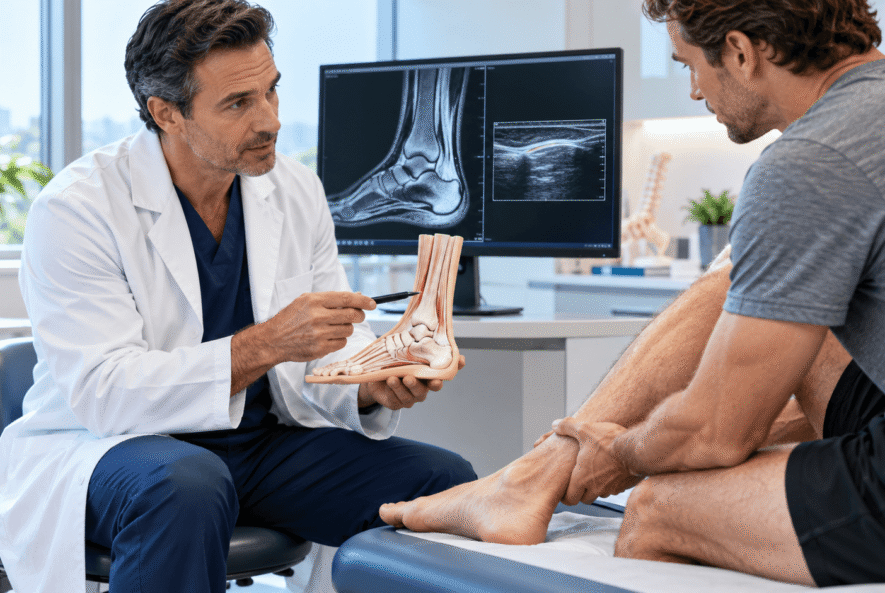
Imaging can help determine whether Achilles tendon pain is due to tendon thickening, partial tearing, degeneration, calcification, bursitis, bone spurs, or another problem.
A physician may recommend:
- Ultrasound
- MRI
- X-rays if insertional pain or heel spur is suspected
Imaging may help answer important questions:
- Is the tendon partially torn?
- Is the condition insertional or midportion?
- Is there calcification?
- Is there bursitis?
- Is the tendon thickened or degenerated?
- Is surgery more appropriate?
- Is regenerative treatment reasonable?
Without accurate diagnosis, the treatment plan may miss the real cause of pain.
What Are the Possible Benefits?
For selected patients, potential benefits may include:
- Reduced Achilles tendon pain
- Improved walking comfort
- Better activity tolerance
- Reduced stiffness
- Improved tendon-related function
- Possible support for tendon healing response
- Possible delay or avoidance of more invasive options in appropriate cases
These outcomes are not guaranteed. Some patients may improve, some may improve only partially, and some may not respond as expected.
A responsible provider should explain that results vary and that regenerative medicine is not a guaranteed cure.
What Are the Risks and Limitations?
Stem cell therapy and other regenerative medicine procedures can have risks and limitations.
Possible risks may include:
- Temporary soreness
- Swelling
- Bruising
- Bleeding
- Infection
- Inflammatory reaction
- No meaningful improvement
- Worsening pain
- Need for additional care
- Delay of a more appropriate treatment
- Product-related risks depending on the procedure
The risk profile depends on what is being injected, how it is prepared, where it comes from, and whether the product is autologous, donor-derived, minimally manipulated, or more extensively processed.
Patients should be careful with clinics that promise guaranteed tendon healing or advertise stem cell therapy as risk-free.
Is Stem Cell Therapy FDA-Approved for Achilles Tendonitis?
This is a very important question.
In the United States, regenerative medicine products have not been approved by the FDA for orthopedic conditions such as tendonitis, osteoarthritis, back pain, knee pain, hip pain, neck pain, or shoulder pain.
You can review the FDA patient resource here:
FDA regenerative medicine patient information.
The FDA also warns consumers about regenerative medicine products including stem cells and exosomes:
FDA consumer alert on regenerative medicine products.
Patients should ask any clinic:
- Is this treatment FDA-approved for Achilles tendonitis?
- What exactly is being injected?
- Is it from my own body or a donor?
- How is it processed?
- Is it being used in an FDA-authorized clinical trial?
- What evidence supports this exact treatment?
- What risks are known?
- What alternatives should I consider?
A clinic should be able to answer these questions clearly without pressure.
What Should You Try Before Stem Cell Therapy?
Many patients with Achilles tendonitis improve with non-surgical care. Before considering regenerative treatment, patients may be advised to try:
- Activity modification
- Calf-strengthening program
- Eccentric loading exercises
- Physical therapy
- Footwear changes
- Heel lifts
- Stretching when appropriate
- Shockwave therapy
- Anti-inflammatory strategies when appropriate
- Temporary reduction in running or jumping
- Biomechanical evaluation
- PRP therapy in selected cases
The right plan depends on the type and severity of Achilles tendon problem.
What to Expect During Consultation
A regenerative medicine consultation for Achilles tendonitis may include:
- Medical history review
- Symptom timeline
- Physical examination
- Gait or movement assessment
- Review of prior treatments
- Imaging review
- Discussion of tendon severity
- Review of treatment options
- Discussion of risks and limitations
- Cost and recovery expectations
- Personalized care plan
The physician may also determine whether additional imaging is needed before treatment.
Preparation guide:
How to prepare for a regenerative medicine consultation.
Recovery Expectations After Regenerative Treatment
Recovery can vary depending on the treatment type, severity of tendon damage, and rehabilitation plan.
In general, patients should expect that tendon recovery may take time. Tendons heal slowly compared with some other tissues because they have limited blood supply and are exposed to repeated mechanical load.
Patients may need:
- Short-term activity modification
- Gradual return to walking or exercise
- Physical therapy
- Progressive loading program
- Follow-up visits
- Avoidance of certain high-impact activities for a period of time
- Patience during tendon remodeling
Regenerative medicine is usually not a same-day “quick fix.” It is often part of a larger recovery strategy.
Realistic Expectations
Realistic goals may include:
- Less pain with walking
- Better ability to climb stairs
- Improved tolerance for exercise
- Reduced morning stiffness
- Improved tendon function
- Possible delay of more invasive treatment
- Better understanding of the tendon condition
Unrealistic expectations include:
- Guaranteed cure
- Instant pain relief
- Complete tendon regeneration in every patient
- No need for rehabilitation
- Permanent results for everyone
- Avoiding surgery in every case
- 100% success rate
A good consultation should help patients understand what is possible, what is uncertain, and what alternatives may be better.
Questions to Ask Before Treatment
Before choosing stem cell therapy for Achilles tendonitis, ask:
- What is my exact diagnosis?
- Is this insertional or midportion Achilles tendinopathy?
- Do I have a partial tear?
- Do I need an MRI or ultrasound?
- Am I a good candidate for regenerative treatment?
- What exactly is being injected?
- Is this treatment FDA-approved for Achilles tendonitis?
- What evidence supports this exact procedure?
- What are the risks?
- What are my alternatives?
- How long is recovery?
- Will I need physical therapy?
- What is the total cost?
- What happens if it does not work?
- When should surgery be considered?
A trustworthy provider should answer these questions clearly.
Cost Considerations
Cost can vary depending on the treatment type, imaging, procedure, follow-up visits, and whether rehabilitation is included.
Patients should ask:
- What is included in the price?
- Does the cost include imaging review?
- Are follow-up visits included?
- Are there lab or facility fees?
- Will I need more than one treatment?
- Is physical therapy included?
- Does insurance cover any part of the visit?
- What are lower-cost alternatives?
Many regenerative medicine procedures for orthopedic conditions may not be covered by insurance, so cost transparency is important.
Learn more here:
Stem cell therapy cost in Miami.
When Surgery May Be Needed
Stem cell therapy is not always the right option. Surgery may be discussed if there is:
- Complete Achilles tendon rupture
- Severe partial tearing
- Persistent pain after long-term conservative care
- Significant tendon degeneration
- Large bone spur or calcification
- Severe insertional disease
- Functional weakness
- Failure of non-surgical treatments
A physician can help determine whether regenerative medicine, continued rehabilitation, PRP therapy, or surgical consultation is more appropriate.
Final Thoughts
Stem cell therapy for Achilles tendonitis may be worth discussing for selected patients with chronic tendon pain who have not improved with conservative treatment. However, it should not be presented as a guaranteed cure or FDA-approved treatment for tendonitis.
Achilles tendon problems are complex. The best treatment plan should be based on diagnosis, imaging, severity, medical history, activity goals, previous treatment response, and realistic expectations.
For patients in Miami, a physician-led regenerative medicine consultation can help determine whether stem cell therapy, PRP therapy, physical therapy, or another treatment option may be appropriate.
Schedule a Regenerative Medicine Consultation in Miami
If you are dealing with Achilles tendon pain, stiffness, or difficulty staying active, schedule a consultation to learn whether regenerative medicine may be appropriate for your condition.
FAQs
Can stem cell therapy cure Achilles tendonitis?
No. Stem cell therapy should not be described as a guaranteed cure for Achilles tendonitis. It may be discussed as a regenerative option for selected patients, but results vary.
Is stem cell therapy FDA-approved for Achilles tendonitis?
No. The FDA states that regenerative medicine therapies have not been approved for orthopedic conditions such as tendonitis.
Can stem cell therapy repair a torn Achilles tendon?
A complete Achilles tendon rupture usually requires urgent medical evaluation and may need surgical treatment. Stem cell therapy should not be used as a replacement for proper evaluation of a tear or rupture.
Is PRP better than stem cell therapy for Achilles tendonitis?
It depends on the diagnosis, severity, imaging findings, treatment goals, cost, and medical history. PRP and stem cell therapy are different regenerative approaches.
How long does Achilles tendon recovery take?
Recovery can take weeks to months depending on severity, treatment type, rehabilitation, and activity level. Chronic tendon problems often require a gradual loading and rehabilitation plan.
Who may be a candidate for stem cell therapy for Achilles tendonitis?
A patient with chronic Achilles tendon pain, failed conservative care, no complete rupture, realistic expectations, and appropriate imaging findings may be evaluated.
What should I bring to a consultation?
Bring imaging reports, MRI or ultrasound results, medication list, previous treatment records, physical therapy notes, symptom timeline, and questions about risks, recovery, and cost.
Medical Sources
- U.S. Food and Drug Administration:
Important Patient and Consumer Information About Regenerative Medicine Therapies
- U.S. Food and Drug Administration:
Consumer Alert on Regenerative Medicine Products Including Stem Cells and Exosomes
- American Academy of Orthopaedic Surgeons:
Use of Stem Cells in Orthopaedics
- American Academy of Orthopaedic Surgeons:
Orthobiologics FAQ
- Mayo Clinic:
Stem Cells: What They Are and What They Do