One of the most common questions patients ask when exploring regenerative medicine is: “Can stem cell therapy regrow cartilage?”
The question is understandable. Cartilage damage is one of the leading causes of chronic joint pain, osteoarthritis, stiffness, and reduced mobility. For many patients suffering from knee osteoarthritis, hip degeneration, shoulder pain, or sports injuries, the possibility of restoring damaged cartilage sounds like a breakthrough solution.
In recent years, stem cell therapy has gained significant attention as a potential non-surgical treatment for joint problems. However, separating marketing claims from scientific evidence is essential.
The reality is that stem cell therapy is a promising area of regenerative medicine, but the science surrounding cartilage regeneration is still evolving. Current research shows encouraging results in some patients, but there are important limitations that every patient should understand before pursuing treatment.
At Stem Cell Miami FL, patient education is a priority. This guide explores what cartilage is, why it is difficult to heal, how stem cell therapy works, and what the current evidence actually says about cartilage regeneration.
What Is Cartilage?
Cartilage is a smooth, flexible connective tissue that covers the ends of bones inside joints. It acts as a cushion and shock absorber, allowing bones to glide smoothly during movement.
Healthy cartilage helps:
- Reduce friction between bones
- Absorb impact during walking and running
- Support joint mobility
- Protect underlying bone structures
- Maintain smooth joint function
Unlike many other tissues in the body, cartilage has a very limited blood supply. Because of this, cartilage does not heal efficiently after injury or degeneration.
Why Cartilage Damage Is So Difficult to Heal
One reason cartilage injuries are challenging is that cartilage lacks its own direct blood circulation. Most tissues rely on blood vessels to deliver oxygen, nutrients, and healing factors.
Since cartilage receives limited blood flow, the body’s natural repair mechanisms often struggle to regenerate damaged cartilage effectively.
This is why conditions such as osteoarthritis tend to worsen over time rather than heal naturally.
Common causes of cartilage damage include:
- Osteoarthritis
- Sports injuries
- Traumatic joint injuries
- Aging-related degeneration
- Repetitive stress
- Joint instability
- Obesity and excess joint loading
What Is Stem Cell Therapy?
Stem cell therapy is a regenerative medicine treatment designed to support the body’s natural healing response.
Stem cells are unique because they can develop into different cell types and produce signaling molecules that influence healing and tissue repair.
In orthopedic and regenerative medicine applications, stem cell therapy is commonly used to address:
- Knee osteoarthritis
- Joint pain
- Sports injuries
- Tendon injuries
- Ligament damage
- Hip pain
- Shoulder conditions
Learn more about Stem Cell Therapy and how regenerative medicine treatments are being used for musculoskeletal conditions.
How Stem Cell Therapy May Help Cartilage
One common misconception is that stem cell therapy simply injects new cartilage into a joint. This is not how regenerative medicine works.
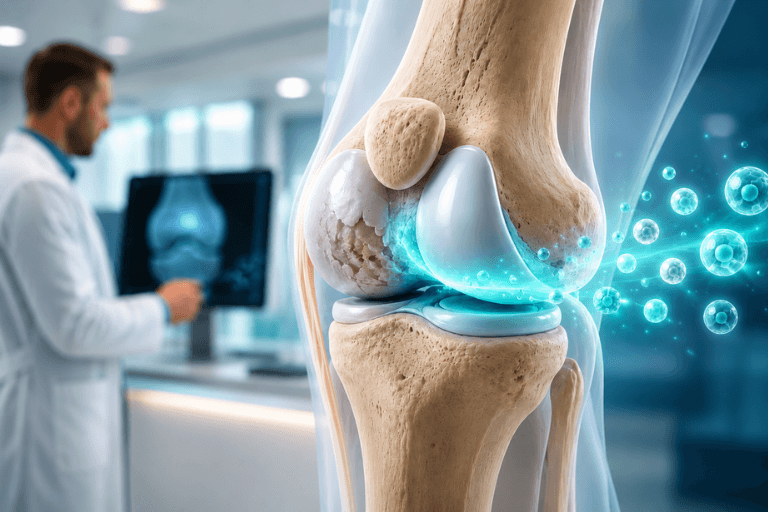
Instead, stem cells may help create a healing environment by releasing growth factors, signaling proteins, and anti-inflammatory compounds that support tissue repair processes.
Potential benefits may include:
- Reduced inflammation
- Improved joint function
- Enhanced healing response
- Reduced pain
- Support for tissue repair mechanisms
Researchers believe these regenerative effects may contribute to improvements seen in some patients with cartilage damage and osteoarthritis.
Can Stem Cells Actually Become Cartilage?
In laboratory settings, certain stem cells have demonstrated the ability to develop into cartilage-like cells known as chondrocytes.
This finding has generated significant excitement within regenerative medicine research.
However, what happens in a laboratory environment is not always identical to what occurs inside a human joint affected by osteoarthritis or long-term degeneration.
While stem cells possess regenerative potential, producing fully functional, durable cartilage inside a damaged joint remains a complex challenge.
What Does the Scientific Evidence Say?
Current evidence suggests that stem cell therapy may help improve symptoms such as pain, stiffness, and mobility in some patients with osteoarthritis and cartilage damage.
Several studies have reported improvements in:
- Pain scores
- Physical function
- Joint mobility
- Quality of life
- Inflammation levels
Some imaging studies have also suggested possible increases in cartilage thickness or cartilage-like tissue formation following stem cell treatment.
However, researchers continue to emphasize that more large-scale clinical studies are needed to fully understand the long-term effects and regenerative capabilities of stem cell therapy.
According to information available through the National Center for Biotechnology Information (NCBI), regenerative medicine remains an active area of research with promising but evolving evidence.
What Researchers Agree On
Most experts agree on several important points:
- Stem cell therapy may help reduce inflammation.
- Many patients report reduced pain.
- Some patients experience improved mobility.
- Regenerative medicine may support healing processes.
- Research continues to expand rapidly.
These benefits may help explain why stem cell therapy has become increasingly popular among patients seeking alternatives to surgery.
What Researchers Still Debate
Despite promising findings, several important questions remain:
- Can stem cell therapy consistently regrow cartilage in humans?
- How much cartilage regeneration is possible?
- How durable is regenerated tissue?
- Which patients benefit most?
- What are the long-term outcomes?
While some studies suggest cartilage improvement, experts generally avoid claiming that stem cell therapy can reliably regrow fully normal cartilage in every patient.
Stem Cell Therapy for Knee Osteoarthritis
Knee osteoarthritis is one of the most common reasons patients pursue regenerative medicine treatments.
As cartilage deteriorates within the knee joint, patients often experience:
- Knee pain
- Joint stiffness
- Swelling
- Reduced mobility
- Difficulty walking
- Loss of function
Many patients explore regenerative medicine because they hope to delay surgery and maintain an active lifestyle.
You can learn more in our guide on Non-Surgical Treatment for Knee Osteoarthritis in Miami.
Stem Cell Therapy vs Cortisone Injections
Patients frequently compare stem cell therapy with cortisone injections.
The difference is significant:
Stem Cell Therapy
- Focuses on regenerative healing
- Supports tissue repair
- Aims for long-term improvement
- Addresses underlying biological processes
Cortisone Injections
- Primarily reduce inflammation
- Provide temporary symptom relief
- Do not regenerate cartilage
- May require repeated treatments
Read our complete comparison: Stem Cell Therapy vs Cortisone Injections.
Who May Benefit Most from Stem Cell Therapy?
Current evidence suggests that patients with mild to moderate cartilage damage may experience better outcomes than individuals with severe end-stage joint degeneration.
Potential candidates often include:
- Patients with early osteoarthritis
- Active individuals with joint injuries
- Athletes seeking non-surgical options
- Patients looking to delay surgery
- Individuals committed to rehabilitation
Not every patient is an ideal candidate. Learn more by reading Who Is Not a Candidate for Stem Cell Therapy?
Can Stem Cell Therapy Prevent Knee Replacement?
This is another common question.
While some patients report significant improvements that help them delay surgery, stem cell therapy is not guaranteed to eliminate the need for knee replacement.
The effectiveness of treatment depends on:
- Severity of cartilage loss
- Patient age
- Overall health
- Activity level
- Joint condition
- Treatment plan
For some individuals, regenerative medicine may provide meaningful symptom relief and improved quality of life.
The Future of Cartilage Regeneration
Researchers around the world continue to study advanced regenerative medicine technologies aimed at improving cartilage repair.
Emerging areas of research include:
- Stem cell therapies
- Exosome therapy
- Tissue engineering
- Growth factor therapies
- 3D bioprinting
- Advanced regenerative scaffolds
As scientific understanding advances, future treatments may offer even more effective approaches to cartilage regeneration.
Final Verdict: Can Stem Cell Therapy Regrow Cartilage?
The most accurate answer is: possibly, but the evidence is still evolving.
Current research suggests that stem cell therapy may help support cartilage repair, improve joint function, reduce inflammation, and decrease pain in certain patients. However, experts generally agree that more research is needed before claiming that stem cell therapy can consistently regrow fully normal cartilage in every case.
What is clear is that regenerative medicine represents one of the most exciting and rapidly developing areas of modern healthcare.
For patients suffering from osteoarthritis, cartilage damage, or chronic joint pain, stem cell therapy may offer a promising non-surgical option worth discussing with experienced regenerative medicine providers.
At Stem Cell Miami FL, personalized evaluations help patients understand whether regenerative medicine may be appropriate for their condition and long-term mobility goals.
If you’re interested in learning more about cartilage damage, knee osteoarthritis, or stem cell therapy options, schedule a consultation today.