Stem cell therapy and other regenerative medicine approaches have received increasing attention as potential non-surgical options for people with joint pain. These treatments are being studied for their ability to influence inflammation, support the body’s healing environment, and potentially improve pain and function.
However, regenerative medicine should not be presented as a guaranteed replacement for surgery. The evidence is still developing, and the appropriate treatment depends on the severity of arthritis, the condition of the joint, the patient’s overall health, and individual treatment goals.
This guide explains the differences between stem cell therapy and knee replacement surgery, what regenerative medicine may realistically accomplish, when it may be considered, and when surgery may still be the more appropriate option.
At Stem Cell Miami FL, patients can learn about regenerative medicine options and discuss whether a non-surgical approach may be appropriate for their individual circumstances.
Quick Answer: Can Stem Cell Therapy Delay Knee Replacement?
It may help some patients manage symptoms and potentially postpone the need for joint replacement, but it cannot guarantee that surgery will be avoided.
Stem cell therapy is being investigated as a treatment for knee osteoarthritis and other degenerative joint conditions. Some studies and clinical experiences have reported improvements in pain and function following cell-based treatments.
The American Academy of Orthopaedic Surgeons (AAOS) notes that orthobiologics show promise for certain musculoskeletal conditions and may, in some cases, help relieve symptoms in earlier osteoarthritis and potentially delay or negate the need for surgery. At the same time, AAOS emphasizes that additional evidence-based research is needed and that these treatments are not appropriate for everyone.
It is therefore more accurate to describe regenerative medicine as a potential non-surgical treatment option rather than a guaranteed alternative to knee replacement.
What Is Knee Osteoarthritis?
Knee osteoarthritis is a degenerative joint condition that develops when the cartilage and other structures within the knee gradually deteriorate. Cartilage normally provides a smooth, protective surface between the bones and helps the joint move with less friction.
As osteoarthritis progresses, cartilage can become thinner and the joint environment can become increasingly inflamed. This may lead to pain, stiffness, swelling, reduced range of motion, and difficulty performing everyday activities.
Common symptoms include:
- Knee pain while walking
- Pain when climbing stairs
- Morning stiffness
- Swelling around the joint
- Reduced knee flexibility
- Grinding or clicking sensations
- Difficulty exercising
- Pain after prolonged standing
- Reduced ability to participate in physical activities
For patients with progressive osteoarthritis, symptoms can eventually interfere with work, exercise, sleep, and quality of life.
What Is Knee Replacement Surgery?
Knee replacement surgery, also known as knee arthroplasty, is a procedure in which damaged portions of the knee joint are replaced with artificial components.
The goal is to reduce severe pain and improve the function of a knee that has been significantly damaged by conditions such as osteoarthritis.
Knee replacement can be an effective treatment for appropriately selected patients, particularly those with severe symptoms and advanced joint damage that have not responded adequately to non-surgical treatments.
However, surgery is still a major medical procedure and involves considerations such as recovery time, rehabilitation, potential complications, and lifestyle adjustments.
The American Academy of Orthopaedic Surgeons provides evidence-based guidance covering surgical management of knee osteoarthritis, including knee replacement.
What Is Stem Cell Therapy?
Stem cell therapy is a form of regenerative medicine that uses cells with biological properties that may influence tissue repair, inflammation, and cellular signaling.
Researchers are investigating how cell-based therapies may affect the environment within an arthritic joint and whether they can help improve symptoms and function.
Potential areas of interest include:
- Inflammation regulation
- Cellular signaling
- Tissue repair support
- Joint function
- Pain reduction
- Mobility improvement
However, it is important to understand that an injection of stem cells does not simply replace missing cartilage with new, fully functioning cartilage. Cartilage regeneration is biologically complex, and researchers are still studying how consistently cell-based treatments can produce meaningful structural changes in human joints.
For a deeper explanation, read our guide:
Can Stem Cell Therapy Regrow Cartilage? What the Evidence Actually Says.
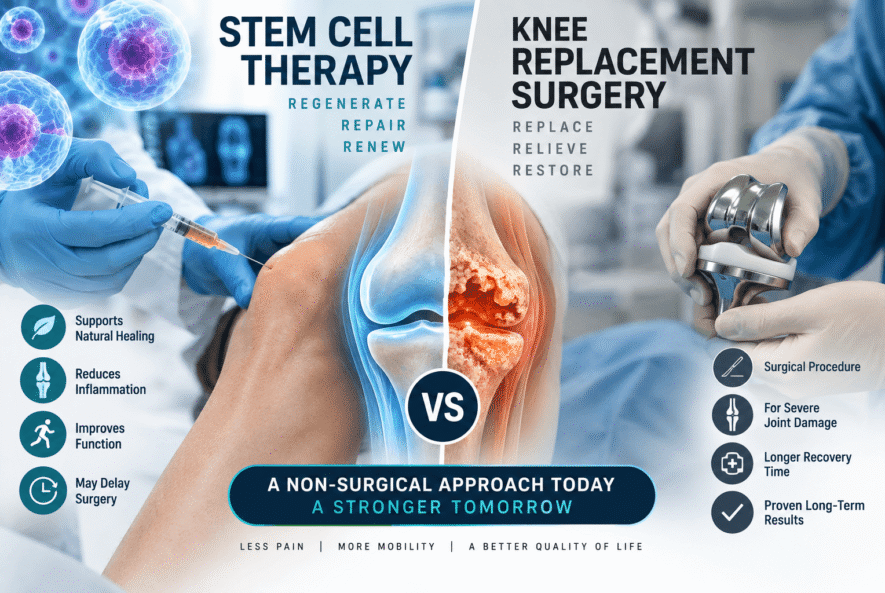
How Is Stem Cell Therapy Different From Knee Replacement?
The biggest difference is the treatment philosophy.
Stem Cell Therapy
- Minimally invasive approach
- Uses a biological treatment rather than an artificial joint
- Focuses on supporting the body’s healing environment
- May help reduce symptoms in selected patients
- Does not physically replace the knee joint
- Research is still evolving
Knee Replacement Surgery
- Surgical procedure
- Removes and replaces damaged joint surfaces
- Designed for advanced joint degeneration
- Can provide substantial pain relief for appropriately selected patients
- Requires postoperative rehabilitation
- Involves surgical risks and recovery
Can Regenerative Medicine Actually Delay Knee Replacement?
This is where expectations matter.
If regenerative treatment reduces pain and improves function for a patient with symptomatic knee osteoarthritis, that patient may be able to remain active and postpone a decision about surgery.
However, this does not necessarily mean that the underlying arthritis has been reversed.
A patient may delay knee replacement because:
- Pain becomes more manageable
- Mobility improves
- Daily activities become easier
- Exercise becomes more comfortable
- Symptoms become less disruptive
The possibility of delaying surgery is therefore different from permanently eliminating the need for surgery.
Who May Be More Likely to Consider Regenerative Medicine Before Surgery?
Regenerative medicine may be worth discussing for patients who have symptomatic knee osteoarthritis but are not yet at a point where joint replacement is clearly necessary.
A patient may consider a non-surgical approach when:
- Knee pain is affecting daily activities
- Conservative treatments have provided limited relief
- The patient wants to explore non-surgical options
- The patient is not ready for surgery
- The patient has mild-to-moderate joint degeneration
- The patient wants to remain physically active
The severity and pattern of joint damage should be evaluated before deciding on any treatment.
What About Severe or Bone-on-Bone Arthritis?
Patients with severe, end-stage osteoarthritis often ask whether stem cell therapy can replace knee replacement.
The answer is not straightforward.
When cartilage loss is extensive and the joint has significant structural damage, regenerative treatments may have more limited potential than they would in earlier stages of disease.
Severe arthritis may involve:
- Extensive cartilage loss
- Significant joint-space narrowing
- Bone changes
- Persistent inflammation
- Major mobility limitations
- Severe pain despite conservative care
In these situations, an orthopedic evaluation is particularly important. For some patients, knee replacement may ultimately provide the most predictable solution for severe symptoms.
Stem Cell Therapy vs Surgery: Recovery Time
Recovery is another major difference between regenerative injections and knee replacement surgery.
Recovery After Stem Cell Therapy
Because treatment is generally performed through an injection rather than an operation, recovery may involve substantially less disruption to daily life.
Patients may experience temporary:
- Soreness
- Swelling
- Stiffness
- Injection-site discomfort
The regenerative response itself may take weeks or months, depending on the individual and the condition being treated.
Recovery After Knee Replacement
Knee replacement involves a more extensive recovery process. Rehabilitation and physical therapy are important parts of recovery, and patients typically need time to rebuild strength, flexibility, and confidence in the replaced joint.
The exact recovery timeline varies considerably between individuals.
Can Stem Cell Therapy Repair Damaged Cartilage?
Cartilage regeneration is one of the most researched areas of regenerative medicine.
Laboratory research has shown that certain stem cells can influence cartilage-related biological processes. However, translating these findings into consistent, durable cartilage restoration in people with osteoarthritis remains challenging.
For that reason, patients should be cautious of claims promising that stem cells will completely rebuild a severely damaged knee.
A realistic goal may be symptom improvement and support for joint function rather than guaranteed restoration of a normal knee.
What Does the Evidence Say About Stem Cells for Knee Osteoarthritis?
Research into cell-based therapies for knee osteoarthritis continues to expand. Studies have investigated pain, function, quality of life, imaging findings, and other outcomes.
The evidence is encouraging in some areas, but it is not yet strong enough to conclude that stem cell therapy can reliably replace knee replacement surgery for advanced osteoarthritis.
AAOS describes orthobiologics as an area with significant promise but also emphasizes the need for additional research and patient education.
The AAOS knee osteoarthritis guidelines also emphasize evidence-based non-surgical and surgical treatment decisions based on the individual patient’s condition.
Important: Is Stem Cell Therapy FDA Approved for Knee Arthritis?
Patients should understand the regulatory status of regenerative medicine before choosing treatment.
The U.S. Food and Drug Administration states that stem cell products are regulated and that regenerative medicine products have not been FDA-approved to treat orthopedic conditions such as osteoarthritis, knee pain, hip pain, or other similar conditions.
This does not mean patients cannot discuss regenerative medicine research or potential treatment options with qualified healthcare professionals. It does mean patients should carefully evaluate what product is being offered, what evidence supports it, how it is regulated, and what claims are being made.
For official patient information, visit the FDA’s regenerative medicine information page.
What Are the Alternatives to Knee Replacement?
Knee replacement is not always the first treatment option for osteoarthritis. Depending on the severity of symptoms, physicians may recommend conservative and non-surgical approaches first.
Potential options may include:
- Physical therapy
- Strengthening exercises
- Weight management
- Activity modification
- Anti-inflammatory medications when appropriate
- Injections
- Bracing
- Regenerative medicine options
The best approach depends on the individual patient.
Read our related guide:
Non-Surgical Treatment for Knee Osteoarthritis in Miami.
Stem Cell Therapy vs Cortisone Injections
Cortisone injections and regenerative treatments are sometimes compared because both may be considered before surgery.
Cortisone injections primarily target inflammation and can provide short-term symptom relief. Stem cell therapy, by contrast, is intended to influence biological healing processes and is being studied for potential regenerative effects.
Neither treatment should automatically be considered a replacement for surgery in advanced arthritis.
Read:
Stem Cell Therapy vs Cortisone Injections.
Stem Cell Therapy vs Hyaluronic Acid Injections
Hyaluronic acid injections are designed primarily to improve joint lubrication and may provide symptom relief for some patients.
Stem cell therapy has a different proposed mechanism and is being investigated as a regenerative approach.
Neither treatment should be promoted as a guaranteed method of rebuilding a severely damaged knee.
Learn more:
Stem Cell Therapy vs Hyaluronic Acid Injections.
What Factors Determine Whether Surgery Can Be Delayed?
There is no single answer that applies to every patient. Several factors influence whether someone can reasonably postpone joint replacement.
Severity of Arthritis
Earlier-stage osteoarthritis may provide more room for non-surgical management than advanced structural degeneration.
Pain Level
A patient with manageable pain may be able to continue conservative treatment longer than someone experiencing severe, persistent pain.
Daily Function
If knee arthritis prevents normal walking, sleeping, working, or exercising, the need for more definitive treatment may become more urgent.
Response to Previous Treatments
The response to physical therapy, exercise, medications, injections, weight management, and other approaches can help guide future decisions.
Overall Health
Medical conditions, activity level, weight, lifestyle, and recovery goals all contribute to treatment decisions.
Can Stem Cell Therapy Prevent Knee Replacement Completely?
There is currently no reliable way to promise that stem cell therapy will prevent knee replacement.
Some patients may experience enough symptom improvement to postpone surgery, while others may eventually require joint replacement despite attempting non-surgical treatments.
The goal should be an individualized treatment decision rather than a promise that one therapy will work for everyone.
Questions to Ask Before Choosing Stem Cell Therapy
If you are considering regenerative medicine for knee osteoarthritis, ask your provider:
- What exactly is being injected?
- Where does the treatment product come from?
- What evidence supports its use for my condition?
- What are the potential risks?
- What results are realistic?
- How many treatments might be recommended?
- What happens if the treatment does not work?
- Should I also consult an orthopedic surgeon?
- Is the treatment FDA-approved for my condition?
A reputable provider should be willing to discuss both potential benefits and limitations rather than guaranteeing a specific result.
Frequently Asked Questions
Can stem cell therapy replace knee replacement surgery?
Stem cell therapy should not be considered a guaranteed replacement for knee replacement surgery. It may help some patients manage symptoms and potentially delay surgery, but evidence is still developing and outcomes vary.
Can stem cell therapy delay knee replacement?
It may help some patients postpone surgery if treatment results in meaningful improvement in pain and function. However, delaying surgery is not guaranteed, especially in advanced osteoarthritis.
Is stem cell therapy better than knee replacement?
These treatments serve different purposes and cannot be directly classified as universally better. Stem cell therapy is a non-surgical regenerative approach under active research, while knee replacement is an established surgical treatment for appropriately selected patients with severe joint disease.
Can stem cells regrow knee cartilage?
Research is investigating whether cell-based treatments can support cartilage repair, but consistent regeneration of fully normal cartilage in an osteoarthritic knee has not been established.
Who should consider knee replacement?
Patients with severe knee osteoarthritis, significant functional limitations, persistent pain, and inadequate response to non-surgical treatments may benefit from an orthopedic evaluation for joint replacement.
Is stem cell therapy safe?
Safety depends on the specific product, procedure, provider, and medical circumstances. Patients should discuss potential risks and the regulatory status of the treatment before proceeding. The FDA warns consumers about unapproved regenerative medicine products and potential serious complications.
Final Thoughts: Stem Cell Therapy vs Surgery
For patients with knee osteoarthritis, the choice between regenerative medicine and surgery is not always an either-or decision. The appropriate treatment depends on the severity of joint damage, symptoms, functional limitations, previous treatments, overall health, and personal goals.
Stem cell therapy may offer a non-surgical option that could help some patients manage pain and function and potentially postpone the need for knee replacement. However, it should not be presented as a guaranteed way to regenerate a severely damaged knee or eliminate the need for surgery.
Knee replacement remains an important and established treatment for patients with advanced osteoarthritis when conservative options no longer provide adequate relief. Regenerative medicine, meanwhile, continues to be studied as researchers work to better understand its long-term effectiveness and appropriate role in musculoskeletal care.
If you are considering regenerative medicine for knee osteoarthritis, the best starting point is a personalized medical evaluation. Understanding your joint condition and realistic treatment options can help you make a more informed decision about whether to pursue regenerative therapy, continue conservative care, or discuss surgery with an orthopedic specialist.
Explore regenerative medicine options at
Stem Cell Miami FL
or
contact our team to discuss your treatment options.